Sunday, December 30, 2012

Teacher of the Month - Rachel Page

Teacher of the Month Questionnaire
Rachel Page
By April Evans


Join Rachel at the Hot Studio
Mondays 5:15-6:30pm All Levels

In addition to being one of New York Yoga's stellar class instructors, Rachel is also a member of the Teacher Training staff, responsible for giving the portion on Yogic Philosophy, Ancient Texts, and the Subtle Body.  Her passion for these elements of Yoga is evident in her teaching style, as well as in her gorgeous tattoos.  She has travelled the world and done multiple teacher trainings, making her point of view very inclusive. Rachel is confident in speaking her own voice, but she does so while creating the space for her students to discover and inhabit their own. 


When did you first discover yoga?
I first discovered yoga in 2000 while I was working out at the Y.  I happened to take a class - I had heard of it but never tried it and I thought "I might as well do it."  After the first time I thought "This is something somewhat athletic that I can actually do!"  I tried everything when I was younger; softball, basketball, and was never really good at them.  Yoga was something I could actually do.

How long have you been teaching? 
For about 10 years, a little over 10 years.  I've done several trainings, but my main training has been through Integral Yoga.  I studied at the ashram Yogaville in Virginia.

What makes your class unique?
I don’t find them particularly unique; they're just a blend of everything I’ve learned, everything that’s been passed down from my teachers.  I feel like everything’s already been done in yoga class. What I’m doing is just putting my spin on what my teachers have taught me. I do a blend of all my teachings, based in Integral Yoga and Jivamukti Yoga namely.

What is your favorite pose to teach?
I’d have to say just sitting in sukhasana for meditation.  I feel like that’s the reason we practice yoga: to find a place where we can be comfortable in the body so that we can sit for longer periods of time. Hopefully eventually we can reach the state of yoga, the state of enlightenment.

What is you favorite pose to practice?
I love savasana, because it’s so challenging. It's harder than the inversions or arm balances, it's when you truly get to test how yogic you really are and if your yoga practice is working in the way it’s supposed to work.  I think it’s easy to stand on one leg for a minute or stand upside down for a couple minutes.  I think being able to be still is really challenging.  It’s the most important asana out there in my opinion.

Best advice for beginners?
Just don’t give up, stick with it.  Don’t get frustrated and don’t compare yourself to anyone. Just be open to whatever comes up emotionally, spiritually, physically.  Stay open.

Best advice for more advanced yogis?
Stop considering yourself an advanced yogi.  If you are really truly an advanced yogi you are an enlightened being.  I don’t think too many of us that come to our mat, even on a daily basis have come to that point yet.  There's a Buddhist quote I really like that I'll paraphrase: “A spoon full of salt in a glass of water makes the water undrinkable, but a spoon full of a salt in a lake makes little difference.”  The point is, just keep an open mind.

What is your biggest yoga pet peeve?
I would say leaving in the middle of savasana, but my biggest one has to do with teachers.  That's yoga teachers who don’t practice ahimsa and who eat meat.  I’m sure a lot of people aren’t going to like that answer, but I have to be honest. 
.
How do you incorporate yoga into your daily life?
Yoga is my daily life.  I live in an ashram and I’ve lived here for over 4 years. So I am on the mat practicing everyday and meditating everyday.  I’m living in a spiritual community so I really can’t separate yoga from my daily life.  It’s part of it.

Passions besides yoga?
Animal rights, riding my bike, spending my time with my friends, and vegan cooking and eating.  I’m really passionate about just working on myself, improving myself everyday and just trying to be a better person, and then accepting if I’m not a good person one day.  Because I'm a work in progress.  I’m not perfect.

Wednesday, December 5, 2012

Pose of the Month - Malasana


Pose of the Month
Malasana – Garland Pose
By April Evans


The holiday season is filled with excitement of many varieties.  We all feel the buzz in the air brought on by the twinkly lights, bustling streets, and busy stores.  We anticipate parties and presents, food and friends, travel and transition.  These feelings are exciting at first, but can soon turn to anxiety as our to-do lists grow and our time to complete them shrinks.  In the hustle and bustle inherent in this season, Malasana, or Garland Pose, takes one of our favorite seasonal decorations and turns it into a wonderful tool for grounding.  This pose is considered by many to be one of the most beneficial poses in the entire asana practice.  It is a perfect pose to open the hips and lower back after you’ve been sitting in a car or on a plane.  It is equally useful a shape for simply feeling the feet root down after you’ve been running all over trying to get your shopping done.  This season give yourself the gift of a few breaths a day in Malasana.

Benefits:
Opens the hips, groins, low back, and ankles
Strengthens the thighs and the abdomen


How to:
If possible, practice this pose with a mirror to your right or left.  This will enable you to check the alignment of the spine.

1. Stand on the mat and separate the feet about mat’s distance apart.  Turn the toes out slightly.
2. Bring the palms to press together at the center of the chest in Anjali Mudra.
3. Anchor the tailbone down and feel the abdomen pull in.  Notice the long line from the tailbone to the crown of the head.
4.  Keep this line intact and hinge the hips back into a low squat, the elbows coming to the insides of the knees. 
5.  Press the elbows into the knees and feel the chest brighten forward and shoulder blades draw together, making the upper spine as straight as possible.
6.  This is where the mirror comes in handy.  If you are very flexible in your hips and legs, it is likely that the low back is rounding.  Lift the hips up a couple inches and tip the chest slightly forward to bring work back into the legs.  If you are tighter in your legs, it is possible that your heels have popped off the floor.  You can place a blanket underneath them or separate the feet a little more and lift the hips a little higher.  If you have any issues with your knees, do not lower all the way down into the low squat.  Instead, take the feet very wide and stay in a high-squat.
7. Ease the back of the neck and the face, take 10 deep, full breaths as the spine lengthens, the legs and feet ground, and the hips open up.

Happy Holidays!

Wednesday, November 21, 2012

Teacher of the Month - Jan Stritzler


Teacher of the Month
November 2012
Jan Stritzler
By April Evans


Join Jan at the York Studio for Gentla Prana Yoga
3:05-4:20pm Mondays

Jan has been a teacher at New York Yoga for over a decade and is adored by loyal and devoted students.  She has been working in the dance and fitness industries for three decades, and teaches to a diverse population of students.  Whether you are a beginner, an advanced yogi, or have sustained an injury, Jan will meet you where you are and help you move forward.  She is passionate about creating an environment where her students can breathe, reflect, and respect the mental and physical states in which they arrive to her class.

When did you first discover yoga?
I discovered yoga as a teenager through the dance.  It was a big part of the dance world in the 1970s, so I’ve known about it for a long time.

How long have you been teaching? 
I did my yoga certification 15 years ago with Prana Yoga, but I’ve been teaching fitness, dance, and combinations of those since I graduated from college in 1982.

What makes your class unique?
My first response is to say that because my training is in Prana Yoga, using sound makes my class unique.  I integrate healing sounds and chakra sounds into vinyasa, which adds a dimension to class that isn’t always there.  The other thing is that while I teach a Gentle class, it is not a beginner’s class.  There is tremendous power in the subtlety of a Gentle class.  I’m interested in consciousness and creating a loving space for people to be loving with themselves.  Everybody comes to class for a different reason, and people hear what they are ready to hear.  In my class you’re really being asking to feel and sense and be with what you need.  That’s not an easy thing.

What is your favorite pose to teach?
I love teaching Tadasana because I feel that it really connects people to their bodies and to their alignment.  It’s a wonderful way of lengthening and opening the body to prepare for everything else.  I also love to teach pranayama and breathing. I like to use sound and breathing within Tadasana. 

What is you favorite pose to practice?
It changes all the time, but this week I've been enjoying Sun Salutations.  I have really been embracing and exploring them for myself.

Best advice for beginners?
Be a beginner and allow yourself not to know, without that being a bad thing! Understand that yoga is not about being able to put your leg behind your head – it is more.  Read a lot from both ancient texts and modern yogis and immerse yourself in it to learn more.

Best advice for more advanced yogis?
Think about where you are in each moment and where your challenge lies.  Maybe your challenge is meditation and stillness.  Maybe your challenge is that headstand you’ve never been totally comfortable with.  Keep questioning, “Where do I go now?” and try not to become complacent.  Understand that yoga is not about being able to put your leg behind your head.

What is your biggest yoga pet peeve?
My pet peeve in general is people thinking you can only do yoga if you are a certain way.  "I can’t do yoga because I’m not flexible,” or “I can’t do yoga because I don’t like to move slowly."  It bothers me when people have preconceived notions about something they just don’t understand.
.
How do you incorporate yoga into your daily life?
I have my own yoga practice every morning.  It is sometimes longer, sometimes shorter depending on what I'm doing, but I do something every morning.  I also sit and breathe before I go to bed at night

Passions besides yoga?
I adore and use essential oils every day.  I also love and adore cooking.  I have to say my biggest passion in my life would have to be hanging out with my family.


Tuesday, November 13, 2012

The benefits of Hot Yoga


You like to sweat, right? Based on the popularity of hot yoga it seems like you're not alone. Our hot classes at New York Yoga are always cooking. But what do you say to people when they ask why you do it? What are the benefits of hot yoga?

Here are eight compelling reasons from Yoganonymous to get into the hot studio. We couldn't agree more.

Haven't taken hot yoga yet? Now is the time. See you in the studio soon.


Thursday, November 8, 2012

Pose of the month - Kapotasana


Pose of the Month
Kapotasana – Full Pigeon
By April Evans

Near Thanksgiving many of us contemplate the many things for which we are grateful.  In the aftermath of Hurricane Sandy, practicing gratitude and compassion can help us heal, help, and rebuild.  Kapotasana, a pose which is equally grounding and heart-opening, is the perfect representation for being rooted in compassion.  The full expression of Kapotasana is not right for all bodies and can take years to achieve.  Respect your body’s boundareies; as long as your intention is to open your heart, you’re still doing the pose.

Benefits:
-Stretches the entire front body (ankles, thighs, groins, abdomen, chest, throat)
-Stretches the psoas
-Strengthens the back muscles
-Extreme heart opener

How to:
Before coming into this pose, ensure that the quadriceps, hip flexors, shoulders, and chest have been warmed up.

1. Come to stand on the knees. Point the toes and press the tops of the feet and the shins into the floor.

2. Take the hands to the lower back and use them to press down and lengthen the lower back.  Feel the tailbone lengthen away from the crown of the head and the lower abdomen engage, firm the thigh muscles.  To find this sensation of stability in the thighs and lower back, place a block between the thighs and squeeze the thighs into the block.  The remaining steps may be done with or without the block.


3.  Lengthen the back of the neck by tucking the chin toward the chest.  Continue to press down on the back of the pelvis with the hands, and on an inhale lean the chest back and tip the heart further toward the sky.


4.  Use the strength of the abdomen and the legs to support the body in this shape while bringing the hands to press together in a prayer shape at the center of the chest

5. Continue to lift the heart, slowly drop the head back.  When the floor behind you becomes visible, begin to reach the arms overhead and drop the hands, then the crown of the head to the floor behind you.


6.  Actively press the shins forward and down into the floor and lift the pelvis as much as possible.  Begin to crawl the hands toward the feet so the forearms come to the floor.  You may be able to grasp the ankles or the calves.

7.  Take at least 5 deep breaths here, feeling the shins and forearms root down while the front of the body opens and expands.

8.  To come out of the pose, walk the hands backward so the forearms lift off the floor.  Use the strength of the arms to lift the head and tuck the chin back in toward the chest.  Take one or both hands to return to the lower back and lift back upright to stand on the shins. 


9.  Hold child’s pose for several breaths.  After such a deep backbend it can also be useful to hold plank pose for several breaths


Tuesday, November 6, 2012

Put on your Yoga Face!


New York Yoga instructor Lulu Hagen was recently featured on Good Morning America with her facial yoga technique. New York Yoga hosted a wonderful workshop on The Yoga Face, and GMA was kind enough to come check it out.

The Facial Yoga techniques that Lulu writes about in her book, Yoga Face, can help improve the strength of facial muscles, and slow the signs of aging. Find out more at the link below, and come in to New York Yoga and check out a class with Lulu! She teaches at the Hot studio on Thursdays at 9:30am.


Wednesday, October 24, 2012

Pose of the Month!


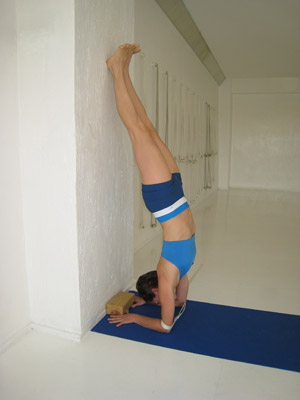
Halloween is a celebration of things that scare us.  For many yogis, inversions are the scariest part of the asana practice.  An inversion is any pose that turns you upside down and gets your heart over your head.  Pinchamyurasana, known more commonly as “Forearm Stand” is a deep heart opener as well as a core strengthener.  A perfect pose to practice during the colder months, this pose stretches out the shoulders and warms up the core.

Benefits:
-Strengthens the shoulders, back, and abdomen
-Stretches the shoulders, neck, and chest
-Like all inversions, activates the “off-switch” portion of the nervous system, creating a calming effect


How to:
Before attempting this pose, ensure that the hamstrings and the shoulders are sufficiently stretched, and do some core-work as well.  Be aware that it can take years to fully realize this pose in the body, and that’s ok.  Try the steps outlined below, and stay and work where you meet your edge – one day you will push through that boundary and onto the next step. No fear!

1. Bring the skinny edge of the mat to a solid wall. Come to hands and knees and lower down onto the forearms.  See that the elbows are as wide as the shoulders and the hands are 6” to 1’ away from the wall. 

2.  Tuck the toes and lift the hips into Dolphin pose (like Down Dog but on your forearms).  Gaze forward at the thumbs.  If it is difficult to keep the elbows from winging out, use a strap and a block as pictured here:


3.  Walk the feet as close to the wall as they will go.  Keep the gaze forward at the thumbs and lift the right leg up.  Notice if the lower back collapses. If so, then scoop the naval in and up so the tailbone lengthens back.  Keep the right leg very active, and lift way up onto the ball of the left foot. 

4.  Start to put a little more effort into the rocking of the left foot and hop the left foot a few inches off the floor.  Maintain a long lower back and a long right leg.


5.  Begin to increase the size of the kicks, keeping both legs as straight as possible on the ascent.

6.  If both feet can reach the wall, lengthen the tailbone up toward the ceiling and then take the right foot off the wall so it stacks on top of the rest of the body.  Then bend the left knee and come to the left toes against the wall.  Squeeze the knees and thighs together and try straightening both legs.

7.  Repeat steps 3-6 on the opposite side.  Take Child’s Pose.

8.  As comfort increases in the pose, move farther and farther away from the wall until you can skip Step 6 and bring both feet up without stopping at the wall first.


Bye-Bye Fear!