Wednesday, March 2, 2011

Find Balance in Trikonasana

March Pose of the Month - Triangle Pose

With spring just around the corner, we are starting to be drawn outside, back into the warmth of the sun. As the days grown longer, we seem to get busier and busier - don't let this take away from finding time for your practice. Take a moment to find your balance and stability in poses like Trikonasana.


Benefits:
  • Helps relieve stress and anxiety
  • Relieves back and neck pain
  • Strengthens and stretches thighs
  • Stretches the hips, groin, hamstrings, calves, shoulders, chest and spine
  • Stimulates abdominal organs - helps improve digestion
 How to:
  1. From Tadasana, step or lightly jump your feet 3.5 or 4 feet apart. Raise your arms parallel to the floor, palms facing down. 
  2. Turn your left foot in slightly to the right and your right foot out to the right 90 degrees. Align the right heel with the left heel.
  3. Firm your thighs and turn your right thigh outward, so that the center of the right knee is in line over the right ankle.
  4. Exhale and extend your torso to the right directly over the right leg, bending from the hip joint. Find strength through the outer heel pressing firmly to the floor.
  5. Rotate the torso to the left, keeping the two sides equally long. Let the left hip come slightly forward and lengthen the tailbone back towards the back heel.
  6. Rest your right hand on your shin, ankle or the floor outside your right foot, whatever is possible without distorting the sides of the torso. A block can also be used to support you here.
  7. Stretch your left arm towards the ceiling, in line with the tops of the shoulders. Keep your head in a neutral position or turn it to the left, eyes gazing softly at the left thumb.
  8. Stay in this pose for 30 second to 1 minute. Inhale to come up. Reverse the feet and for the same length of time to the left.

Friday, February 18, 2011

Meet the Teacher of the Month

Kelly Stackhouse's light-hearted nature is good for the yogi soul. She will encourage you to have fun and approach your practice with a sense of humor. Beginners and advanced practitioners alike will find her vinyasa flow challenging with moments of surrender to breathe and to really be in the moment. Expect supportive adjustments to help you move deeper and a sequence that satisfies all the way through to savasana.


You can find Kelly at York Ave on Fridays for her 8:25am Hour of Power or her 9:35am Vinyasa All Levels; and at Hot on Tuesdays for 5:15pm Hot Vinyasa All Levels. Whether you check her out at New York Yoga or New York Yoga HOT, you will be greeted with a warm smile and have a fantastic class ahead of you.

When did you first discover yoga?
I first discovered yoga in 2003 when I was on a meditation retreat in Thailand. We practiced yoga every morning and I was amazed to see how I could improve in so little time. I noticed my toes inching forward each morning when I stepped my foot between my hands - little improvements like that really got me interested.


How long have you been teaching?
Six years. I studied with Kathryn Beet at Yoga Space, in Toronto, and was certified in 2005.


What makes your class unique?
I don't take myself too seriously. I think there should always be moments in class where students are really having fun. I smile and joke even if students do not respond right away, I think its still appreciated and reaching them - every now and then a student smiles back.


What is your favorite pose to teach?
Pigeon. There is a certain way to talk students into relaxing much more deeply than they thought they could. I think people are intimidated by pigeon. It works such a big muscle; it can be such a release. I like teaching passive poses because I get to teach people how to give up working so hard and find surrender instead.


What is your favorite pose to practice?
Wheel. It is a struggle for me, always has been. Since it's the most challenging, I like to work on it the most. Its good for people to work on a pose they want to run away from, it says a lot about what is going on in their practice. I also love dancer because its really beautiful.

Best advice for beginners?
To be patient, to be open, to let any intimidation go. I think yoga sometimes feels like a strange world and can be confusing at first. Just take in a little at a time and it will start to make sense if you are open to it. Yoga is for everyone.

Best advice for more advanced yogis?
Sometimes backing off is the bigger challenge. I see people pushing so hard that they lose the alignment or purpose of the pose they are trying to do and it can be difficult to bring someone back. Sometimes less is more.

What is your biggest yoga pet peeve?
I don't like to image of yoga being super-hippy - yoga is as much for the hedge fund guy as it is for the stay at home mom. I don't like when yoga is typecast.

Reader questions...

How do your York and Hot classes differ?
I always base my classes on the energy of the room. There tends to be a more relaxed vibe at the York Studio. I think the heat inspires higher energy. So I'd say my class is special to both place and totally depends on the atmosphere.

Passion besides yoga?
I am a bit of a running coach. I love photography and art; I'm often at galleries or museums around the city. And I like to travel. 

Tuesday, February 1, 2011

Help Cupid's Arrow in Urdhva Dhanurasana

February Pose of the Month - Urdhva Dhanurasana

With Valentine's Day approaching, it may be time to add some heart openers to your practice. For our pose of the month, we want to shoot our hearts to the sky - with Urdhva Dhanurasana or Wheel Pose. Since this is also referred to as Upward Bow Pose, it is a perfect match for February. Use this super strengthening pose to increase energy, relieve stress and stretch the low back.

Benefits:
  • Strengthens wrists, arms, legs, buttocks, abdomen and spine
  • Expands chest and lungs
  • Increases energy
  • Counteracts depression
  • Theraputic for asthma, back pain, infertility and osteroporosis
How To:

  1. Begin lying on your back. Bend your knews and set your feet on the floor, heels as close to the sitting bones as possible. Place the hands beside the head with the fingers pointed back towards the shoulders.
  2. Begin to lift the hips off the floor - keep your thighs and feet parallel.
  3. Press firmly through the feet and hands to lift up onto the crown of you head - keep your arms parallel.
  4. Press your feet and hands into the floor; begin to lift your head off the floor as you straighten your arms. Turn the upper thighs slightly inward and firm the outer thighs. Let the head hang to look at the floor.
  5. Imagine the bed behind your heart and focus on expanding to aim up and out. Advanced practitioners can raise one left to the sky. Stay in the pose anywhere from 5 to 10 seconds or more, breathing easily. Repeat anywhere from 3 to 10 times.
  6. Reverse your steps to come out of the pose, lower your body gently to the floor.

Wednesday, January 19, 2011

Meet the Teacher of the Month

Hillary Helmling’s classes are a beautiful combination of creative sequencing and her vibrancy. Her smile and encouragement will keep you flowing strong as you work your way through a challenging series of poses – you may not even realize how hard she got you to practice until it’s all over! Hillary is wonderful at bringing something new to each one of her classes. She also encourages her students to lose themselves (or really to find themselves) in the flow.

Check out Hillary’s 9:05pm Candlelight Vinyasa on Tuesdays or her 5:50pm Vinyasa All Levels on Sundays. She will quickly become one of your New York Yoga favorites. 

When did you first discover yoga?
I discovered it before I even realized I was doing yoga – I had a dance professor in college who used a lot of yoga poses in her warm ups. I was really drawn to those movements.

But I truly discovered yoga after I moved to New York. I came to the city to perform and was feeling overwhelmed by the auditions, rejections and just the competitive nature of the business. At the time I was living near Union Square and stumbled upon a studio down there – I instantly fell in love with it. Yoga brought me back to my center.

How long have you been teaching?
About three and a half years.

What makes your classes unique?
My classes have a good balance of breath, alignment and flow – I believe that breath is the most important component of any yoga practice. I want my students to find their own journey in the practice and try to give them lots of options so they can each find their flow. 

My classes are pretty challenging; I’m big on core work and strength training and I like to find interesting flows to keep the students present.

What is your favorite pose to teach?
It varies from class to class. I usually have one rock star pose that is challenge, one that a student wouldn’t normally do in their regular practice, maybe an inversion or arm balance but definitely a pose that is a little more in depth.

What is you favorite pose to practice?
If my body is craving something more restorative and calming then forward folds or supported bridge. Otherwise maybe arm balances or headstand – I love head stand.

Best advice for beginners?
Don’t come in with an idea of what you think yoga is. Be open-minded to experiencing the practice of the class. New students should also keep it simple – don’t try to over work. And breathe.

Best advice for more advanced yogis?
Breathe. Don’t be afraid to step back from your practice and approach it as if you were a new student.

What is your biggest yoga pet peeve?
When people judge yoga before they’ve even tried it. When I tell people I’m a yoga teacher, I often get the response, “I can never do yoga because I’m not flexible.” I tell them it’s not about having a flexible body it’s about having a flexible mind.

Reader questions…

Your bio says you came to New York to perform – are you still pounding the pavement?
Yes. Yes I am. But I have a much more grounded approach thanks to my yoga practice.
One of the great things about New York is that you can have lots of interests and pursuits – you just need to keep a good balance.

Favorite thing to do besides yoga?
I really like to read. I’m in a very serious book club.  I also like to run and bike in Central Park – anything that gets me outside.

What are you reading right now?
I’m reading: The Forgotten Garden, by Kate Morton, and Under the Banner of Heaven, by Jon Krakauer – I like to have one fiction and one non-fiction book going at a time.

Flip Your Perspective in Salamba Sirasana

January Pose of the Month - Supported Headstand

There is no better time to take on a new view than the new year. While you are thinking up and sticking to those resolutions this year, include headstand in your practice to help stimulate your mind and relieve stress.
By reversing the normal effects of gravity, salamba sirsasana rests the heart, deepens breathing and aids circulation. It also improves memory and concentration – who couldn’t use more of that this year?

Benefits of this pose include but are not limited to:

  • Calms the mind
  • Strengthens the arms, legs and spine
  • Improves balance
  • Feeds a supply of fresh oxygen-rich blood to the brain cells
  • Creates a sense of physical and emotional well-being
  • Rests the heart and other organs with change of blood flow
  • Relieves pressure on the lower back
  • Helps relive varicosities 
  • Improves digestion 
How to:
If you are new to the pose, use a folded blanket on your mat for more head support and position yourself near the wall. This way, when you kick up you have the wall for security to start.
1. Come to your hands and knees. Lower to forearms and clasp your hands - they should make a triangle shape.  
2. Place the crown of your head on the floor, with the back of your head cupped by your interlaced fingers
3. Raise the hips in the air coming into a modified downward facing dog-pose. The weight should be placed on the flat spot at the top of your head. Make sure that the elbows are shoulder width apart and the head equidistant from each elbow.  
4. Walk the feet in towards your head until your hips are over your shoulders – keeping the legs as straight as possible. 
5. Kick up one leg and then the other. Or, you can get into the pose by, pulling your knees up to your chest and your heels close to your buttocks. Bring the bent legs up - be sure to keep the legs together as you raise the knees. To assume the final position, unfold the legs so that they point straight upwards. 
6. Press down strongly into your forearms to keep all your weight from coming into your neck and head.  Your body and spine should be aligned just as they are in tadasana, the simple standing "mountain" pose.
7. Reach up through the balls of your feet and rotate the thigh bones inward slightly. Hold for at least 10 breaths.

Thursday, December 16, 2010

Meet the Teacher of the Month

From yoga and meditation to reiki and massage there is little Kristin Leal is unaware of if it pertains to the body. She even holds certifications in neuromuscular and myofascial release. Kristin is a student for life – curious and ever expanding her knowledge of anatomy, movement and yoga philosophies – it is this inquisitiveness and depth that makes her a New York Yoga favorite. She has a fabulous sense of humor in her class room and creates a space for beginners and advanced practitioners alike to energetically explore their practice.


Kristin has been a guest on New York Yoga’s 200 hour Teacher Training faculty many times. She created the Kaya Yoga programs and has worked with Alan Finger to further his development of the Ishta Marma Point teacher training as well. It is no question that she will continue to be a powerful force at New York Yoga and to the greater yoga community.


Kristin teaches at the York studio on Mondays at 6:05pm and 7:35pm; and on Wednesdays at 4:35pm and 6:05pm.

Kristin, when did you first discover yoga?

I first discovered yoga in 1993 – a friend of mine from my dance program took me to a class at the old Jivmukti studio. I started practicing there because the stretching complimented my dance practice. I didn’t know what anyone was talking about at first but was curious about non competiveness nature of yoga – totally different from the dancing I was doing at the time.

How long have you been teaching?
About fifteen years.

What makes your class unique?
I try to balance the seriousness of your enlightenment with not taking yourself too seriously. I like to make the teachings practical and not just an exercise for class that day, so that people can bring it into their everyday life.

What is your favorite pose to teach?
I don’t have a favorite pose to teach. I prefer to see the students find themselves energetically in each posture – the specific posture itself is fairly irrelevant.

What is you favorite pose to practice?
All poses have different energetic effects and compliments. My main goal is to connect with who I am beyond the labels, attributes and conditions. I practice to connect with my higher self beyond the pose. But I guess you could say anything that opens me up enough to meditate or anything that is going to help me to be a more present teacher that day.

Best advice for beginners?
Patience.

Best advice for more advanced yogis?
Patience.

What is your biggest yoga pet peeve?
Actually I am trying to work on compassion; I want to work past my pet peeves. I used to have some pet peeves about class manners but now when something ruffles my feathers I’m trying to notice where it comes from and get beyond that.

Reader questions…

Who are your biggest influences?
Sharon Gannon and David Life early on, Katchie Ananda was my teacher at Jivamukti in the early nineties, and for the past three years Alan Finger has been a huge influence personally and professionally.

Are there any other projects like the “Yoga Fan” coming up?
I am currently co-writing a book with Alan about aligning the western anatomy with the more eastern esoteric anatomy.

Thursday, December 2, 2010

Taking Time in Tadasana

December Pose of the Month

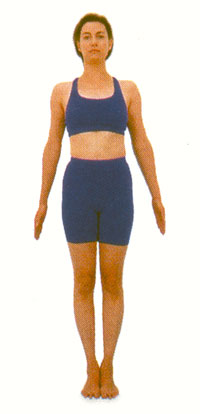
During the holidays, its easy to get overwhelmed with commitments and responsibilities. Tadasana, or Mountain Pose, provides us with a solid base to start any day, especially a busy one. While it is a basic yoga posture, it also improves posture and creates space for the internal organs to work more efficiently.

Benefits of this pose include but are not limited to:
  • Relief from sciatica
  • Reduction in flat feet
  • Stronger abdomen, thighs, knees and ankles
How to -

1. Stand with the bases of your big toes touching, heels slightly apart (so that your second toes are parallel). Lift and spread your toes and the balls of your feet, then lay them softly down on the floor. Rock back and forth and side to side. Gradually reduce this swaying to a standstill, with your weight balanced evenly on the feet.

2. Press your shoulder blades into your back, then widen them across and release them down your back. Without pushing your lower front ribs forward, lift the top of your sternum straight toward the ceiling. Widen your collarbones. Hang your arms beside the torso.

Tadasana is usually the starting position for all the standing poses. But it's useful to practice Tadasana as a pose in itself. Stay in the pose for 30 seconds to 1 minute, breathing easily.